

Holding Your Horses
More on my new business and a millennia-old analogy

Feel like sending a little extra love my way? ↓
Last week, I mentioned I recently launched a business, one of the core focuses of which will be workshops for helping individuals, professionals, and business leaders clarify their ideas. There are a variety of applications I envision for this—different formats, different audience, different objectives—but that’s the core concept.
It’s the simplest distillation I’ve come up with during the two-month-long process of challenging myself to pin down the thread that’s been running through all the disparate kinds of work I’ve done: ghostwriting, chaplaincy, consulting, content strategy, and even selling life insurance.
That last one might be a slight stretch, but for the most part, that’s the aspect of all of these roles that I feel the most confidence, enjoyment, and satisfaction with: I help clarify people’s ideas to help them get what they want.
And in a community filled with artists, creatives, nonprofit leaders, and small business owners, more often than not, the thing they want is also what I want: to have more visibility, and to have more people see, understand, appreciate, and support what they do.
As a writer, I see this as fundamentally a storytelling problem. But also, as a writer, I see myself (past, present, and future) attracting clients who view it as a writing problem. I’ve had countless people—some of whom were actual clients and some of whom were not—tell me, “I have all these ideas, all these things I’ve experienced and learned from life that I want to share with the world; people always tell me I should write a book, but I just don’t know how to write well.”
Or some version of that.
What I’ve learned from the clients I’ve actually worked with—whether they were ghostwriting clients, or people seeking spiritual counsel, or companies in need of marketing services—is that the biggest problem they have is a misidentification of the problem itself, or at least a problem in properly triaging a collection of problems.
This brings me to the other thing I mentioned last week, which is that, for thousands of years, many different religious traditions have used a similar analogy to describe the degree of careful, skillful coordination that’s required to tame and guide the torrent of human consciousness: the analogy of the charioteer.
For reference, here are a couple of examples from last week of what I’m talking about:
“Know the Self as lord of the chariot, the body as the chariot itself, the discriminating intellect as the charioteer, and the mind as reins. The senses, say the wise, are the horses; selfish desires are the roads they travel. When the Self is confused with the body, mind and senses, they point out, he seems to enjoy pleasure and suffer sorrow […] “the soul is the owner of the chariot, the intellect the charioteer, the mind the reins, the sense organs the horse and the body the chariot.”2
—Katha Upanishad
“Picture a charioteer. He is seated in a vehicle, propelled by a horse, guided by himself. Intellect is the ‘vehicle’, the outward form within which we state where we think we are and what we have to do. The vehicle enables the horse and man to operate. The horse, which is the motive power, is the energy which is called ‘a state of emotion’ or other force. This is needed to propel the chariot. The man, in our illustration, is that which perceives, in a manner superior to the others, the purpose and possibilities of the situation, and who makes it possible for the chariot to move towards and to gain its objective.”3
—Sufi parable
But I’d like to get in on the fun, too, because I think this is actually a good analogy for illustrating the problem I’m looking to solve with one of my primary workshop offerings. And, as with many problems, you can close about half the distance between you and the solution just by properly identifying the problem.
For my purposes, I’m going to call the chariot the concrete thing that people I work with are trying to move from point a to point b: oftentimes, for them, it’s a book.
The horses represent the actual content of the writing. This is, again, the part that most ghostwriting clients I’ve worked with feel like they have. Which is good. Because I don’t know anything about acquiring horses. How much does a horse even cost? Would I need to supply the stable? Where does the literature currently stand regarding horses’ preferences for sugar cubes vs carrots vs salt licks?
The reins are the thing they don’t think they have—maybe they feel they don’t have reins at all, maybe they just don’t think they have good grip, or maybe they don’t feel confident in steering. It’s the other side of writing: not the content, but the technical skills and all the structural stuff by which those fiery horses can be tamed and controlled all the way from point a to point b.
And the charioteer is, you know, the person, the client…no real need for substitution with this part of the analogy.
Okay, now, if you refer back to those ancient chariot analogies above, you might notice a conspicuous lack of attention to certain essential elements of the whole chariot thing:
The frickin’ chariot itself.
I mean, we’re going to break things down into charioteer, chariot, horses, reins, even roads, but we’re going to ignore the fact that chariots themselves consist of many moving parts?
Well, to their credit, there are some spiritual figures who hit upon this, like Confucius who taught:
“I do not know how a man without truthfulness is to get on. How can a large carriage be made to go without the cross-bar for yoking the oxen to, or a small carriage without the arrangement for yoking the horses?”1
Or the 20th century Zen master and teacher Shunryu Suzuki who wrote:
“Buddha said the same thing about the good ox driver. The driver knows how much load the ox can carry, and he keeps the ox from being overloaded. You know your way and your state of mind. Do not carry too much!”2
These represent some key overlooked problems that I’ve encountered with clients who are a little too eager to whip their horses into action.
What are you trying to deliver from point a to point b? Is it the chariot itself—as in, you just want to write a book for the sake of writing a book? Totally fine if you do. I kinda do.
But maybe you’re looking to transport something else—some set of messages or teachings. Is your cargo bulky enough to necessitate a chariot (a book), or is it compact enough to fit into one of those cartoony hobo sticks with the polka-dotted cloth bundles at the top? In which case, just get rid of the chariot and ride the horse itself—write an email or a LinkedIn post or whatever.
But if you do need to write a book, or something shorter but still substantial, like a series of blog posts, let’s start examining the chariot itself. I don’t know what an oxcart cross bar is, but I do know that if you want an animal to tug something along, it needs to be connected to the tugging vessel and it needs to be strong enough to do the tugging: do you actually understand what’s involved in writing blog posts or a book in terms of time commitment or, if you’re hiring a ghostwriter, financial commitment?
You gotta figure those things out first. And many people do.
So, if you do need to haul a chariot and you do have the horsepower necessary to do so, the next problem is still not a reins problem—it’s not a writing problem.
And this is the key insight: I don’t think writing workshops are going to be particularly appealing to or useful for people who lack confidence in writing, even if they really, really need to write something.
The good news is, there is something that can be worked on that involves far less time and skill development than the technical writing skills that get taught in traditional writing workshops, and it’s analogous to the one thing that’s still missing from all of these other chariot analogies…
Where. The fuck. Are the wheels?
Think about it. You’ve got your horses, you’ve got your chariot, you’ve got your destination, you’ve got your reins. You try to get going and you’re just not getting very far. The horses are struggling to move, you’re struggling to steer them or will them into action. Of course you conclude you’re bad with the reins! You’ve got everything else, don’t you? So it must be a problem with your ability to use the reins.
But you don’t have everything. You don’t have wheels.
Possibly, maybe, you could get where you need to go without wheels—if you have enough time, enough horsepower, and enough willingness to expend an extra amount of both. You could pull a chariot without wheels. It just wouldn’t go as fast, would be harder to steer, and would just be harder for everyone and everything involved: the horses would struggle, the chariot would get all scuffed up, you’d get frustrated, and you might even have to jettison some of the important cargo just to get through the whole ordeal.
But why do that? Just take a little bit of extra time getting some wheels and learning how to attach them to the chariot.
The wheels are storytelling.
Storytelling is so effortless it’s nearly unconscious, in the same way you don’t need to actively focus on the wheels of a chariot to make them roll. Storytelling is something our brains do naturally. We communicate through and learn from stories practically from the day we learn to speak.
When I work with ghostwriting clients, more often than not, it quickly becomes clear to me that the people who struggle with writing view writing as something like creation ex nihil: creation out of nothing—you know, like the thing that God does. No wonder writing feels daunting. It feels daunting to me, too, when I approach it that way.
But when you start with storytelling, writing ceases to be a creation problem and instead becomes a translation problem. You’ve expressed everything you need to express verbally. Now you just have to translate that verbal expression into writing. Then we can see how good or bad you are with the reins.
Here’s what this means for my workshop business.
My plan is to host storytelling workshops. I think they can help business leaders clarify their messaging, but I also think they can help adults and children improve their writing, and I think they can even help people make meaning in life by clarifying their spiritual, ethical, and/or existential ideas and beliefs.
Until you’ve expressed ideas in some form, they don’t really exist in a way that allows you to see them as they truly are. And for many people, writing is a very difficult first way to express something. Storytelling, comparatively, is not.
But how often do we actually sit down with another person and, at length, explain our most important ideas or tell our most important stories: the ones that are at the heart of who we are, the work we do, the ideas and beliefs we hold dear? We’re used to giving the 30-second elevator pitch version of these things, but that’s not good enough. Those are, like, wheels made out of straw or something—probably not gonna cut it for your charioteering endeavors.
So, in my workshops, I will have people pair up, take turns telling each other “stories”—not necessarily fictional, not necessarily personal stories, but just a 15-minute narration of something you want to have clarified for yourself. Then, I will ask each person to write the other person’s story as if the other person wrote it.
I’m effectively making people ghostwrite stuff for each other. Why? Because this helps you get past the layer of myopia that’s crusted over the ideas you’re looking to clarify that is the result of 30-second elevator pitch after 30-second elevator pitch.
When you have to write someone else’s story in someone else’s voice, it teaches you the mechanics of what it takes to write your own story in your own voice. It teaches you how to handle the reins—the basics, at least. I know this because I have done this countless times myself—writing other people’s stories in other people’s voices—and it helped me immensely over the years in learning how to write effectively and how to make my own voice come across in my writing.
Hopefully, after I lead my first workshop, a week and a half from now, I’ll have some more data to support this conviction and some interesting reflections to share here.
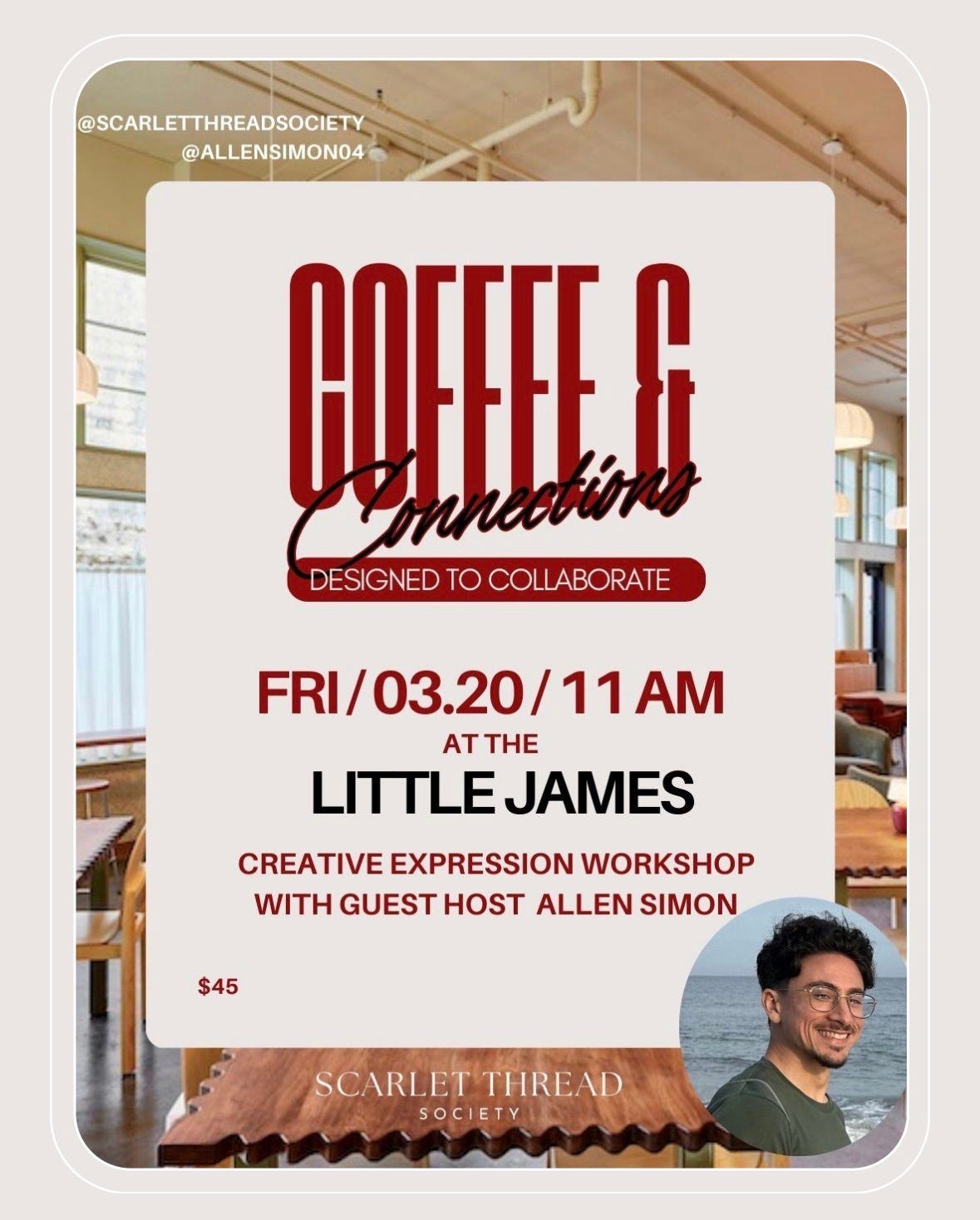
If you’re in Savannah on March 20th, consider signing up and coming out. And if you’re in the much larger bucket of non-Savannahians, keep holding your horses—I’ll have remote stuff to offer soon enough.
Thank you for reading! You are the chillest!
Please consider subscribing and/or sharing with a friend who’s as chill as you 😎
James Legge, trans, “Analects” in Confucian Analects, The Great Learning, The Doctrine of the Mean, Kindle Edition (Pantianos Classics, 2017), 2:22.
Shunryu Suzuki, Zen Mind, Beginner’s Mind (Boston: Shambhala, 2011), 43.
Lots of framing and telescoping here. Or are “framing” and “telescoping” actually two different ways of looking at the challenges of human cognition as it flails to represent “itself”, as it skitters, flickers, and contorts to encompass “experience”? Or to what extent are “self reflective consciousness” and human “experience” the same amoebic manifold?
Story telling (or is it story composition) might be a good anchor. Or is it an “Ariadne’s ball of twine” that unspools, knots, and tangles on its own when it doesn’t rear up like a Cobra or throttle like a Python? For me, when it comes to “stories” the issue is “revision.” Not the revising of wordings, pacings, sequencing, and images, but the seeking of new ways to envision the stories which we dredge up painfully, which absorb and consume us, and blinker, veil, and target our attention and understanding.
Where do “our” stories come from? How are they functions of some imagined “life force”? And if there were such a force, wouldn’t it include death — and not always the kind of peaceful, self actualized ones, we might prefer to “envision”? Stories, especially the most banal and unrecognized ones are powerful. Stories, even the most compelling and memorable ones can be diabolically misleading.
We are not the stories we tell ourselves we are, but what that means we do not seem to know.
(Now, I gotta go read “The Human Condition” by Hannah Arendt.)