

Return To The Root Of Aloofness
Working my way toward a different creative approach

Feel like sending a little extra love my way? ↓
I have this clear memory of being in preschool and sitting by a low-to-the-ground table upon which a bunch of Legos were splayed out. There was a group of boys playing with them. I was sitting on the floor beside them, simply watching. I wasn’t feeling shy. I wasn’t feeling dissatisfied. I was doing exactly what I wanted to be doing in that moment.
One of the boys looked at me and asked, “Do you want to play?” Staring quizzically back, I softly replied, “no.”
In retrospect, I imagine my answer must’ve sounded just as strange to him as his question sounded to me. He was, of course, doing the kind, polite thing of trying to include me, which was very sweet of him. He could’ve just as well ignored the silent weirdo sitting beside him or told me to scram.
The reason the question sounded strange to me, and the reason I gave the answer I did, is that I already felt included; I already felt like I was participating. I was doing what felt natural and comfortable for me: sitting and quietly observing.
“How could that be enjoyable?” some people might wonder. I don’t know. And yet, it was. There was no part of me that felt compelled to join in on the actual playing. There was also no part of me that judged myself for feeling that way or felt shame or any sense that I was doing the “wrong” thing or withholding myself from doing the “better” thing.
Over time, those boys became my friends. I didn’t ask them to become my friends. I didn’t try to impress them or force a friendship with them. I simply continued sitting with them and watching quietly because…
There was no because—it’s just what I did. For some reason, that was enjoyable for me. And for some reason, my quiet presence was enjoyable for them. Maybe they liked having someone there who could appreciate the fruits of their labor, someone who could witness the whole building process from beginning to end, of which each of them could only be fully conscious of his own particular part.
A Cloud Of Nondescript Confusion
I think I understand why this memory has crept up into my awareness lately. Over the past couple of weeks, I’ve been feeling something that’s hard to put into words, though it’s a fairly familiar feeling. It’s something I feel periodically, maybe two or three times each year.
It feels like a cloud of nondescript confusion passing over my head. I try to interrogate it, but it gives me no clues, no insight into why it has arrived and toward what it might be gesturing: the nature of the confusion itself remains unclear.
So, I’ve been groping in the dark trying to better understand and respond to this feeling. There’s some vague sense of “off-ness,” like something is out of place or askew. It’s thankfully not enough to disrupt the overarching sense of joy I’ve been feeling in my life lately, but it’s enough to make me think I’m being urged to see something in a new way or to take some step forward (or upward or downward or backward—who knows?).
With no particular leads to follow, I start taking stock of every aspect of my life: social life, professional life, creative life. How am I spending my time? Am I spending time with the right people? Do I feel good about my professional work—both in the present and where it might be leading me in the future? Do I feel good about the creative work I am or am not doing at the moment?
All of that’s well and good and probably important to think through from time to time.
But the Lego table-adjacent silent sage in me finds all of this rather icky. If I were someone who cared about having a clear vision for the future and having everything all figured out ahead of time, would I really have studied religion in college and grad school? Would I really have been bouncing around between jobs as disparate as ghostwriting, e-commerce content strategy, selling life insurance, and consulting for a university’s office of religious life? A clear, linear path was never in the cards for me.
I’ve been trying to think my way through this cloud of confusion, which has been about as ineffectual as waving around a knife and trying to use it to slice up an actual cloud.
Maybe all this overthinking is the cause of the problem rather than its solution: maybe it’s a cloud of smoke that had been trickling out of my ears, issuing forth from my overtaxed, overheated brain.
Not-Knowing-Whyness
In addition to the Lego story, the other thing that recently popped into my head somewhat spontaneously was a particular quote from the Daoist text, The Book of Chuang Tzu:
“All living things return to their root, return to their root, not knowing why. Constantly in darkness, constantly in darkness, and throughout their physical existence they never depart from this.”1
I thought I was being called to write some posts about Daoism, so I did, but that didn’t feel quite right either. So, I set them to the side and kept reflecting on this quote.
Maybe I’m being called to “return to my root.” But what does that mean? I started flipping through the annotated pages of my copy of Red Pine’s translation of the Tao Te Ching, which includes snippets of commentary from Chinese scholars across post-Tao Te Ching history. And one such line of commentary caught my eye:
Huang Yuan-Chi says, “We all possess something good and noble that we don’t have to seek outside ourselves, something that the glory of power or position cannot compare with. People need only start with this and cultivate this without letting up.”2
And then this one, too:
Lu Hui-Ch’ing says, “Only those who find but one thing can act like this. Thus to have less means to be content. The reason most people cannot act like this is because they have not found one thing. Thus, to have too much means to be confused.”3
What is my “one thing” that I’ve always had, that I’ve never had to seek outside of myself, though its prominence may have ebbed and flowed throughout my life?
Initially, I thought it was something like quietness or stillness or patience: all things that have come pretty naturally to me throughout my life and which are well-represented in that Lego story.
But this is not one thing; these are three things. What’s the one thing that’s at the root of these things?
All living things return to their root, return to their root, not knowing why.
For me, I think it’s something like “aloofness”—as though my one root is itself a kind of “not-knowing-whyness.”
It’s a thread that I can trace through my life, and one that I think has been conducive to feelings of contentment.
Toward the end of high school, I went to a college recruiting event, listening to representatives from four different universities in some hotel conference room make their little pitches about why we should apply to their schools. One of them was Rice University, which ended up being my alma mater. It was also the only college I applied to.
Yes, I shit you not. I had partially filled out applications for two other schools, but once I got accepted into Rice, I never bothered to finish the other applications.
I remember my guidance counselor telling me how foolish it was for me to be so narrow-minded about my college search; I remember the perplexed tones in the voices of my classmates and teachers when they asked me why I had settled on this little liberal arts college in Texas when I likely could have been admitted to any school I applied to.
But I also remember how stressed out everyone else seemed at that time, applying to 10, 12, 15—however many colleges—and then having to choose one out of the handful that admitted them. All the “should” and “what ifs”: “Should I go to this school or that one?” “What if I’m making the wrong decision?” What an absolute headache!
Me? I was just chillin’.
I had a great time in college, and I’ve never once questioned whether or not I made the “right” choice. How could it not have been the right choice? There was hardly any choice involved. It’s simply a thing that I did, and it worked out well.
What More Is There To Say?
My mind turns next toward my social interactions. I’ve never really asked myself why I spend time with the people I spend time with, or why I like some people and not others—to be honest, it still puzzles me a bit when someone asks me this directly.
It rarely occurs to me to slice someone up and analyze what their good qualities are, what their bad qualities are, which things they would have to change about themselves for me to like them “better.” They’re simply there, and I’m there with them. As long as that’s the case, it’s so because I like them well enough. What more is there to ask of them, and what more is there to say?
I was content to just sit next to that Lego table without knowing why and, perhaps more importantly, without realizing that I was doing something without knowing why.
Once someone asks you why you’re doing something—whether that someone is you or someone else—it shatters the tranquility of that “not-knowing-whyness,” doesn’t it? You have to start asking yourself this “why?” question. And, coming up blank, you’re likely to either feel some sort of shame or confusion or anxiety about not knowing why, or else you must manufacture some answer that alleviates that anxiety. And then you end up shrouded in a cloud of confusion.
Or, I do, at least.
As time has gone on, I’ve had to scale back my aloofness, my “not-knowing-whyness.” There’s simply no way to deal with the demands of modern adult life without a “knowing-whyness” persona. And yet, I will always feel this pull to return to my “not-knowing-whyness” root. Sometimes I forget to follow that pull. Sometimes I forget how to follow that pull. But it is there nonetheless and, to the extent that I am able to follow it, I tend to feel better: more content, more at peace, more like myself.
There’s been a lot of “knowing-whyness” that’s crept into my writing over the past year: I’m writing about religion and spirituality because it’s a topic I know a lot about and which (I think) other people find interesting; I’m writing about this stuff from a gentle, personal perspective because I’m not a traditional religious insider; I write this post because it’s a good follow-up to that post; I plan out arcs of posts ahead of time because I need to know I won’t run out of ideas; I post on Tuesdays because it’s good to be consistent; I make little clay sculptures to use as images for my posts because it’s good to have images and, again, good to be consistent, to have some semblance of brand recognition.
When I reflect on all of this, it makes me feel as though I’ve strayed a bit far from my root of “not-knowing-whyness.” I know writing is important for my wellness, and it’s something I care about and take pride in. But why do I have to stick to a particular topic or genre or schedule?
To reference the short story I wrote for my last post, why do I have to only make chairs?
Yes, my publication is called “Chill Theology.” But if I really let myself be a bit more spontaneous about writing whatever I feel like writing in the moment, is religion and spirituality going to completely disappear from all of my posts? Probably not. It’s been an important part of my educational, professional, and personal life for over a decade. I mean, I didn’t set out for this post to be about religion, and yet I ended up referencing a couple of religious texts.
But even if I write a post that doesn’t have anything explicitly religious or spiritual in it, is that really going to piss off a critical mass of you all? I mean, I hope not.
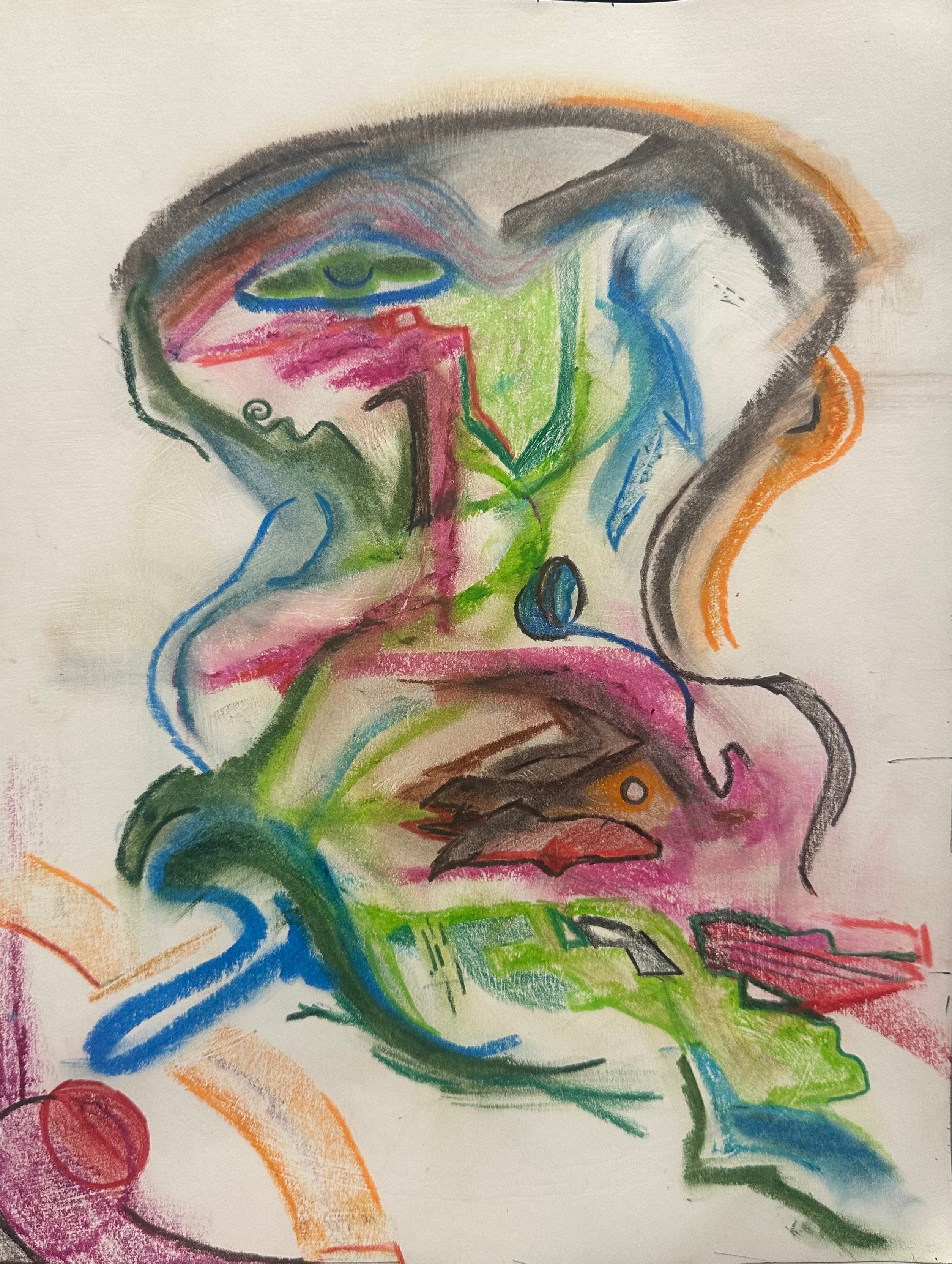
So, that’s that. Things here might start looking quite a bit different. I had a good run with my little clay sculptures, but I’m more drawn toward making abstract pastel/crayon drawings these days—which, by the way, don’t need to be Tuesdays.
And what more is there to say?
Thank you for reading/listening! You are the chillest!
Please consider subscribing and/or sharing with a friend who’s as chill as you 😎
Chuang Tzu, The Book of Chuang Tzu, Penguin Classics edition, Trans. Martin Palmer (New York: Penguin Books, 2006), 88.
Lao-Tzu, Taoteching, Trans. Red Pine (Port Townsend, Washington: Copper Canyon Press, 2009), 27.
Ibid., 45.
This return to your essential self is really inspiring, and it’s fun to see that accompanied by more freedom of movement.
Interesting link between “not knowing why-ness” and “aloofness.”
Interesting to consider the similarities and differences between being “challenged” with “Why?” questions by yourself or by other people.
Sometimes (? or always?) when we challenge ourselves with such questions, we do it by impersonating others (real or imagined.)
Sometimes when we try to justify or explain our actions (or non actions) we grasp at facile rationalizations provided by others… OR we carefully construct rationalizations, excuses, or deflections based on some combination of impulse, intention, calculation, and creative syntheses or elisions of ideas/opinions that we have been exposed to or have absorbed. Sometimes we believe these justifications in part or in whole, critically or non critically — at least for a while. But the truth is we probably DO NOT KNOW.
As for returning to some “source,” I’m not there. We are being thrust forward from the unknown into the unknown. Call it a “fall,” a “launch”, a “trajectory”, an “expansion”, a “contraction”, “gravity”, “entropy”, “the big bang,” or “whatever”. Maybe there are times when we enjoy the ride. Maybe there are sometimes when we feel a sense of balance. Maybe there are some times when we feel like we are able to recognize and choose the right ways to be responsible. But I feel like I should question those times as much as I should be suspicious of those feelings of being out of control or in despair.