

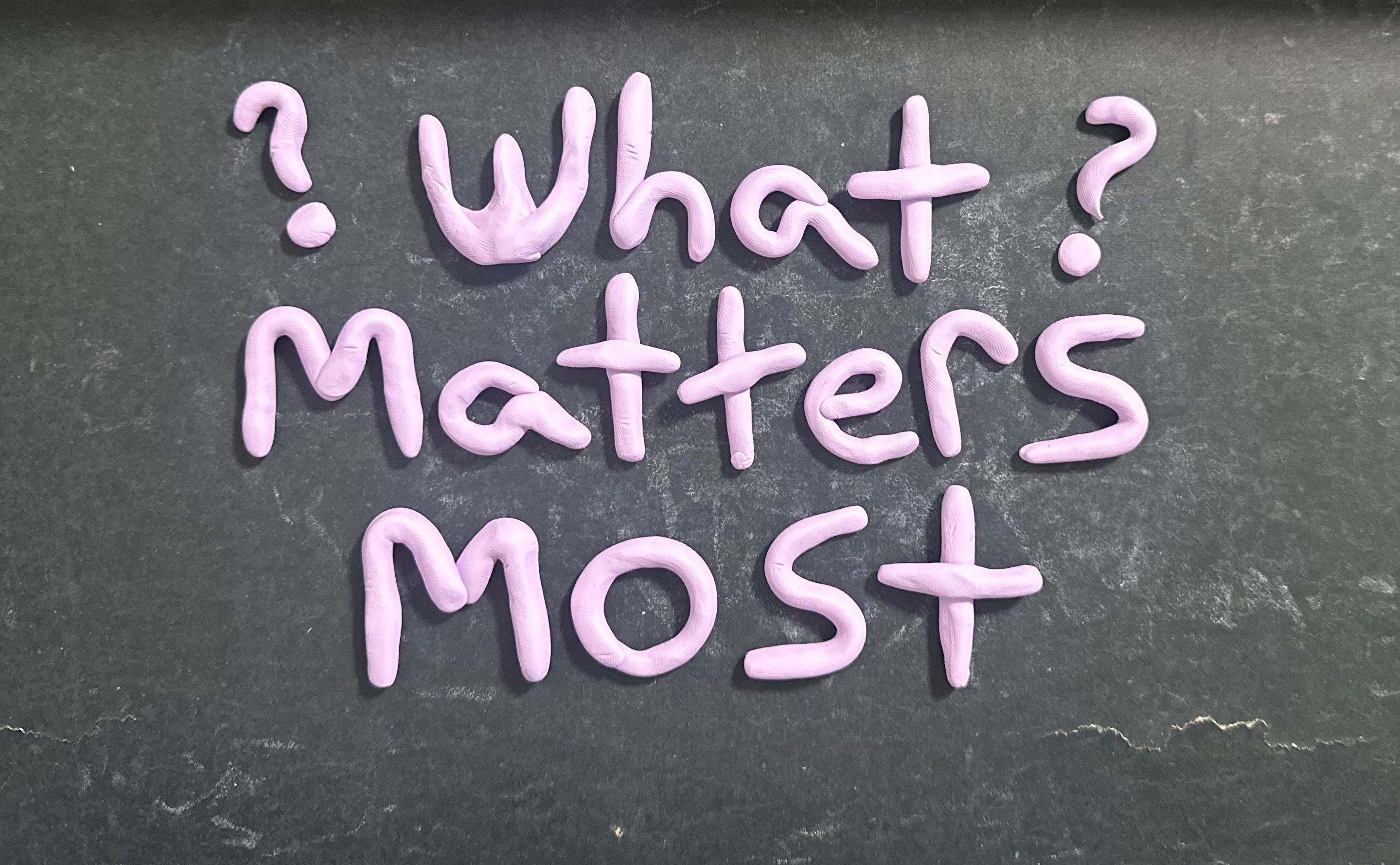
What Matters Most
A reflection on the value of religion

Feel like sending a little extra love my way? ↓
It’s been about 8 months since I wrote something on here explicitly about religion, even though that’s pretty much all I wrote about on here for the preceding 11 months—back when this publication was “Chill Theology,” and not “Chill Reflections,” a title which accurately reflects the lack of specificity that’s defined my writing for the past 35ish weeks.
All of that is well and good. It was creatively necessary for me to branch out and explore different topics and genres, many of which I’ve enjoyed and will continue to work on.
But I do feel it’s time to come out of theology retirement and get back to writing about religion at least some of the time.
As I put that particular thinking cap back on, I find myself returning to many of the same questions I tried answering for myself back when I first started:
Why do I write about religion? What am I actually trying to say about it? What do I actually want to show people about this topic that I have some subject matter expertise in?
I can now approach and attempt to answer those questions in different ways than I initially did.
It’s a good difference.
Back when I started writing on Substack a year and a half ago, I set a goal for myself that I would publish something without fail every week, a commitment I stuck with for a long time: at least a year.
Now, I’m getting back to being more diligent about meeting that goal, but the difference is I no longer have to write articles about religion every week. I have other things I can and will write: short stories, poems, personal essays, etc.
I don’t have to write about religion; I get to write about religion. Only when I want to. Only when I have something to say.
And today, what I have to say is this:
At its core, religion is about what matters most.
Simplify, simplify
It’s a simple statement, maybe even an obvious one. But, to be a bit more specific, I mean to say that I think religion is primarily a way to think through what matters most, with everything else being a secondary result of that initial impulse.
In my older posts, I regularly made the point that religion doesn’t just have to be about God.
I was making that point, not because I don’t believe in God or because I was trying to stamp out belief in anyone else, but simply because I wanted to invite people to reengage with religion regardless of their feelings or beliefs about the concept of God.
The reason that was and remains important to me is that I really do think, at its core, religion is a way to take a step back and think about what matters most. And when I think about what is needed most in the world right now, that’s pretty high up there on the list.
Life is really fast-paced (there’s another simple, obvious statement).
It’s tough to keep up with work, with relationships, with bills, with household chores, with current events, with TV shows, and now, with the latest AI models.
We put our heads down to keep up and forget to look up.
Religion is the finger that gently lifts our chins up toward the skies once more. The kooky symbols and outfits and depictions of supernatural forces and beings have coalesced into a handful of globally enduring institutions over the years, but they’re all just systematic ways of reminding ourselves to spend time contemplating what matters most.
That’s religion in its simplest form.
Questions, answers, and question-answers
Yes, for many religions, what matters most is God.
But really, God is more like a placeholder for the more fundamental answers to the question of “what matters most?” Take “creation,” for instance: the creation of the universe, and of humanity, is what matters most. We toil to feed and shelter ourselves, but once our most basic survival needs are taken care of, this is the thing that we should be focusing on. That’s why the first book of the Old Testament is Genesis: to its author(s), creation is evidently what mattered most.
From the focused effort to interrogate that question comes the concept of God, which itself invites its own questions: “Who or what is God exactly?” Which, to me, is actually just a restatement of the initial question: “What matters most?”
God is the Creator.
God is Love.
God is Peace.
Creation is what matters most.
Love is what matters most.
Peace is what matters most.
So, to the extent that religion helps people explore what God is, what God means to them, I think it is living up to what I consider its simplest, most sacred mission: helping people think through what matters most to them, which is critical to finding meaning and living a good life.
But to the extent that religion sweeps the question of “what matters most?” under the rug by slyly answering it with another question that it then refuses to adequately address—“what is God?”—I think it is failing in this mission, a failure which is reflected in the many emerging alternative religious identities today that go by names like “spiritual but not religious,” or simply, “seeker.”
What is it that “seekers” are seeking? Religions have a tendency to rush to the rescue with answers, but seekers aren’t seeking convenient answers—they (we) instead are seeking something worth seeking. What we need is not help answering a question, but rather help thinking through that question: the question of what matters most.
Why many such people, myself included, often find traditional religion dissatisfying is that it all too often answers open questions like “what matters most” with closed answers.
What matters most becomes a particular concept of God, or even religion itself.
Story time
There is a parable that shows up in the writings and teachings of various Indian religious traditions, which reflects the deeply pluralistic religious landscape and attitude that has long been a characteristic of the Indian subcontinent.
Though it has many slight variations, the basic story is this: there are a handful of blind men gathered around an elephant. Each one touches a different part of the elephant, prompting them to arrive at very different conclusions about what this elephant is: the one touching the thick, rough hide of its leg feels something akin to bark and concludes it must be a tree; another touches its long, slender trunk and decides it must be a snake; yet another touches its smooth, pointed tusk and feels a spear.
Classically, this is interpreted as a parable about God, and how each religion—represented by each blind man—contains partial truths about a subject that is too grand for any single tradition to comprehensively capture. And it is meant to illustrate the folly of arguing over who’s right, when the wisest course of action would be to work together and piece all these parts of truth together.
Very nice, very wholesome.
My interpretation of this parable, though, is to see it as a perfect illustration of how, all too often, the “what matters most” question gets lost in the shuffle.
If you approach this as a parable about what matters most, I think we would all have to agree that what matters most in this particular situation is:
“Ay, yo, there’s a fucking snake and a fucking spear, and maybe this is not the right time or place for us to be having a philosophical pissing contest about whose elephant-groping should be considered the most authoritative.”
Beyond the bubble
I’m not trashing religion as a whole. Both forms of religion exist today, just as they always have: the form that replaces important questions with inadequate answers, and the form that is more dedicated to exploring those questions, always resisting the impulse to answer them with finality.
The reason I’ve always leaned toward the literary side of religion is that literature is not confined to a particular time or space. If the institutional resources religion has to offer in your particular community are helping you explore the question, “what matters most,” great. But if they are not, you don’t need to give up on the whole enterprise of religion entirely.
If “God,” for instance, is not a satisfying answer to the question of “what matters most” for you, there are countless pages of texts from across religious traditions spanning all of recorded human history that can help you think through that question.
And yes, this still holds true for God-centric religions like Christianity, which has a rich history of mystics and theologians for whom God is what matters most, but who recognize that that answer is itself another question that demands gallons of ink worth of contemplation and inquiry: Meister Echart, St. Teresa of Avila, Teilhard de Cahrdin, CS Lewis—just to name a few.
And, then, there are, of course, countless other thinkers you can turn to for very different pictures of what matters most. It’s not always a single thing. “What matters most” is different from “what is the single thing that matters more than everything else?”
For Confucius, it is some combination of knowledge, order, and relationships; for Lao Tzu, maybe a mix of simplicity, balance, and harmony; for the Buddha, it might be truth, wakefulness, and loving kindness.
The point—or, rather, my point—is that religion is and will remain an important and valuable way to probe the question “what matters most?”
And by “religion,” I mean the total collection of all that religion has produced—not just “religion” as a league of powerful institutions that thrive off of making others feel bad for being different. Religion is much more than that.
The sacred spaces and art and literature and rituals are all so many ways of temporarily extracting us from the bubble of our day-to-day lives that makes us feel like the elements of basic survival—working, eating, sleeping—are what matter most, rather than being the means that enable and motivate us to ask what matters most.
All of these elements of religion are various channels through which we can routinely immerse ourselves in a different kind of bubble that forces us to think beyond the day-to-day. And, by repeating those rituals and/or engagements with religious spaces and cultural artifacts, we are training ourselves to keep that question top of mind with greater and greater frequency beyond the religious bubble.
Shunryu Suzuki, one of the great teachers and popularizers of Zen Buddhism in the West, once noted that “when your practice is calm and ordinary, everyday life itself is enlightenment.”1 In other words, religion can (I think should) be a kind of training that helps us come closer and closer to asking ourselves that question at every moment, even if we can’t always answer it, despite how engrossed we might be in the necessary day-to-day stuff.
My point (more succinctly) is that the value of religion, at its best, is less about the particular answers to the question of “what matters most?” it offers, and more about the ways it facilitates constant, serious focus on that question, regardless of what we might be occupied with in our lives at any given moment.
A core of goodness
At the start of this essay, I mentioned that my early Substack writings were prompted by and continued to prompt me to think through questions like, “Why do I write about religion?” and “What am I actually trying to say about religion?”
Those questions quickly deepened into “Why did I ever start caring about religion in the first place?”, “Am I religious?”, and “Whether I’m religious or not, why is it still so important for me to spend time on it, thinking and writing and otherwise?”
To tackle these questions in order, I cared because I’ve always cared very deeply about figuring out what matters most in life. It seems strange to go through life without doing so, like toiling away at fitting together a bunch of loose nuts and bolts, and metal and wood, without at least some cursory idea of what you’re trying to build.
Am I religious? I once quipped that I’m religious but not spiritual, inverting the more popular alternative religious identity of “spiritual but not religious.” I still think that’s true because I do think that religion is, at its core, all about taking that question of what matters most seriously. I take spiritual beliefs and practices much less seriously. I don’t think they’re bad or stupid or anything. They just tend not to factor as prominently into my own reflections on what matters most.
Why is this all so important to me? Why was it important for me to write this? I suppose it’s because, as someone who still believes in religion as a force for good in the world, I want to help keep things that way.
There’s a lot not to like about the current state of some religious forces and institutions in the world today. But wherever there are thick, dark webs of corruption and lies and charlatanism, I’m convinced that there is a core of goodness and truth at the heart of it all. In fact, I’m convinced that these webs only can grow in such places. The important task is to continually clear these webs off and polish that core so that it maintains its luster.
It is easy to just see the dark webs, and for good people to leave religion behind, failing to see the very real good reasons that exist for sticking with it, while bad people remain and double down for all the wrong reasons.
Whatever the deal is with all these emerging alternative religious identities—spiritual but not religious, new age, neo-pagan, even my own “religious but not spiritual,” if you want to throw that in there and adopt it yourself (for a small licensing fee, of course)—however amorphous and cringy they can seem at times, I think they are seeking that core of goodness.
It is too early to really pin down what these religious identities are, what their core beliefs are, what they will become, and whether they will continue to splinter or eventually coalesce into a singular, more defined thing. But, I do think they have the potential not to compete with or replace more traditional institutions and forms of religion, but to wake up and inspire them, reminding them that what matters most is asking the question,
“What matters most?
Epilogue
Is it a cop out for me to keep saying how much the question of “what matters most?” matters to me, and then not offer up any of my own personal thoughts on the matter?
Or is it simply a dramatic, strategic rhetorical choice?
As I said, I don’t think the point of this question is to arrive at a singular, final answer.
But, if you’re still here, I do appreciate you reading all of this, so I’m going to throw you a bone. After a few decades of thinking seriously and constantly about this question, and having now written this essay, there is one thing that stands out to me, which is “peace.”
There are many other things I value and try to live up to in my life—love, kindness, simplicity, knowledge, meaning, purpose—but they all seem to be orbiting around, and in service to peace: inner peace for myself, and the desire to help others inch toward peace within themselves. Whatever I’m doing at any point in time, I try to hold onto or work toward peace. It’s not the thing I think should matter most to everyone else—I don’t think should is a useful concept here—but it seems to be what has often mattered most to me throughout my life. And I’m not quite sure I would’ve understood that about myself, if not for what I’ve learned and gained from religion.
Thank you for reading! You are the chillest!
Please consider subscribing and/or sharing with a friend who’s as chill as you 😎
Shunryu Suzuki, Zen Mind, Beginner’s Mind (Boston: Shambhala, 2011), 43.
What matters most?
Doesn’t that change with age? What matters most to a newborn is not what matters most to a two year old. What matters most to a seven year old is very rarely what matters most to a fourteen year old …and on it goes. What matters most to an expectant mother is not necessarily what matters most to a soldier on a battlefield or a chief of state. Could what matters most to a former professor, comfortably retired in a Boston suburb be the same as what matters most to someone living in a tent today in Gaza? (Maybe…)
What matters most? How often does “religion” or “god” or “gods” or “theology” or “philosophy” or “psychology” really address that question for anybody in any serious (never mind) comprehensive way? How often (never mind how successfully) do any of those even try to address (or even clarify) such a question?
Then there may be a set of questions about what matters most about “religion”? What matters most about “God” or “gods”? What matters most about theology or philosophy? What matters most about science or politics? … Those questions, like “Doe a deer,” may just bring us back to “What matters most about being alive?” Or “What matters most about being vaguely aware that one is alive and sentient and that one is almost certainly going to die?” And, how similar is that to “What matters most about death?”
What we call “science” today is arguably based on a series of refinements on what was once called “philosophy” or more precisely “natural philosophy” whose origins are often (mis?)understood as part of an ongoing attempt to differentiate itself from religion—or at least from religion that relies on “supernatural,” “mystical,” or “untestable” explanations. But not all religion(s) (including modern, medieval and ancient “Western” ones were (or are) especially hostile to “logos” or “reason” or “empiricism” (as opposed to “mythos”) — and when they were (or are), that’s more related to religion’s function as a governing force in SOME, but not ALL, polities.
What we call science and philosophy today might actually be just as concerned with asking questions about the various ways that people think (or hold beliefs) about “what is most important” as are the most thoughtful adherents of (or apologists for) any religion. But the most thoughtful approaches (I think???) are more concerned with clarifying the terms of that question and the conditions to which it applies. And that might all devolve (or rise to) seeking to ask better questions.
You definitely have a new fan! I appreciate the clarity and humor with which you write. As someone who loves questions, it was very welcoming of you to direct people to focus on asking rather than answering. And further yet, I also have found myself focusing on "peace". I look forward to reading more!